Introduction
The research of Dr. Alachkar focuses on understanding the neurobiology of neurological and psychiatric disorders and identifying therapeutic targets for optimal treatment. Particularly, we are interested in searching for novel treatment for Parkinson’s Disease, Schizophrenia, Depression, Postpartum Depression, Anxiety. Our approaches range from genetic to molecular, to chemical to behavioral studies.

The Discovery of a New Neurotransmitter: A Novel Treatment of Parkinson’s Disease
 In Parkinson’s disease dopamine neurons die, and this causes movement deficits like tremor (shaking) and hypokinesia (lack of movement). Treatment of Parkinson’s relies on replacing the lost dopamine. Since dopamine cannot cross the blood brain barrier, patients administer the dopamine precursor L-DOPA which reach the brain and is converted to dopamine. While initially, L-DOPA successfully reverses parkinsonian symptoms, as the treatment progresses, its effectiveness decreases, and leads to side effects such as dyskinesia, fluctuations in mobility, and freezing episodes. These symptoms are sometimes worse than that of Parkinson’s disease.
We discovered that an unexpected molecule, ophthalmic acid, acts as a neurotransmitter and improves movement better than dopamine in Parkinson’s disease induced in mice. Its duration of action is longer and more profound than L-DOPA. It acts via a different mechanism involving the calcium sensing receptors (CaSR).
We challenge the traditional management of Parkinson’s disease. We discovered a new approach by suggesting ophthalmic acid as a mode of treatment. In mice, ophthalmic acid reverse Parkinson’s deficits more efficiently than L-DOPA. Because it does not act directly on the dopamine system and has a longer duration of action, it is expected that it will not lead to the deleterious side effects that are associated with the traditional Parkinson’s disease treatment.
Exploring Cilia Functions in the Brain (Neurons’ Antennae and GPS)
 Once considered vestigial structures, primary cilia are now recognized as key players in sensory perception and cellular signaling, though their impact on brain functions is still not fully understood. The projects in this theme aim to elucidate why neurons need cilia and how cilia, once considered rudimentary organelles, affect higher-order brain functions, particularly cognition. Our approach combines advanced methodologies, including optogenetics, chemogenetics, sophisticated tracing techniques, and genetic tools utilizing Cre-lox technology, as well as behavioral approaches. Developed in collaboration with Dr. Pierre Baldi, we have integrated AI-driven techniques, for precise measurements and data analysis. We have already made several discoveries in this domain:
1) Our extensive analysis of over 10 million brain cilia has revealed unique orientation and length patterns. We discovered that cilia in the brain tend to orient at specific intervals, notably at primary compass or Cartesian axes directions, indicating that their orientation is not random but follows a structured pattern. 2) We demonstrated that cilia length displays substantial variations across different brain regions. 3) We have uncovered the versatility of cilia, by showing that their lengths can be influenced by a variety of factors, ranging from environmental to optogenetic. 4) Our studies further uncovered the integral role of cilia in the brain’s internal timing mechanisms: 4a) Cilia-associated genes in primate brains follow circadian rhythms; 4b) Cilia length and spatial orientation exhibit daily rhythmic fluctuations. Remarkably, both cilia length and orientation vary between light and dark phases, dependent on the specific brain region; 4c) This chronobiological influence is evident in behavior as well, where we have shown that cilia removal from certain brain regions such as the striatum can lead to disruptions in timing-dependent functions
and circadian rhythms. 5) Our investigations have also mapped the dynamic shifts in brain cilia-associated genes throughout human life, hinting at their potential role in age-associated neural alterations. 6) Lastly, we have discovered that cilia-associated genes are dysregulated in psychiatric disorders, particularly schizophrenia, suggesting a potential connection between cilia and mental states and disorders.
Long-term impact of maternal and intergenerational trauma

This project deals with the mechanistic association of intergenerational stress transmission with depressive mood and social functioning impairments. We aim to establish early biomarkers for identifying at-risk individuals and developing preventive/treatments at the earliest practicable ages to protect against depression development. We demonstrated that stress exposure during pregnancy (through exposure to predator odor) induces social deficits and depressive-like behavior in progeny through mechanisms involving early and long-lasting mitochondrial dysfunctions and epigenetic modifications. We established 2-HG as an early predictive biomarker for stress-induced behavioral deficits. Furthermore, we proved that early pharmacological correction of mitochondria dysfunction by ALCAR could permanently restore molecular aberrations and reverse the behavioral deficits induced by prenatal stress. We use in vitro, ex vivo, and in vivo studies, and we integrate neuroanatomical, biochemical, pharmacological, in-vivo brain imaging, behavioral, functional, and bioinformatics approaches.
The neuronal circuit of maternal behavior and postpartum depression
 The mother-infant relationship is of particular importance because it forms the earliest experience of social interaction, which profoundly impacts cognitive, emotional and social development. Poor maternal care, such as neglect, has been steadfastly linked with subsequent increased offspring’s risk for deficits in cognitive performance, academic achievement, and psychopathology such as antisocial and aggressive behaviors. This project focuses on understanding the neurocircuits that regulate the initiation of maternal behavior and postpartum mood disorders such as postpartum depression.
Oxytocin is known as the key regulator of the onset of maternal behaviors. Very little is known, however, about the hypothalamic circuits that are regulated by oxytocin to induce the onset and termination of maternal care. We showed that another neuropeptide, melanin concentrating hormone (MCH), plays an important role in regulating maternal behavior and postpartum mood. We integrate neuroanatomical, pharmacological and genetic approaches to investigate role of oxytocin- MCH neurocircuit in the regulation of maternal behavior and postpartum depression.
Prenatal Micronutrients Programming of Psychiatric Disorders (Schizophrenia & Autism)
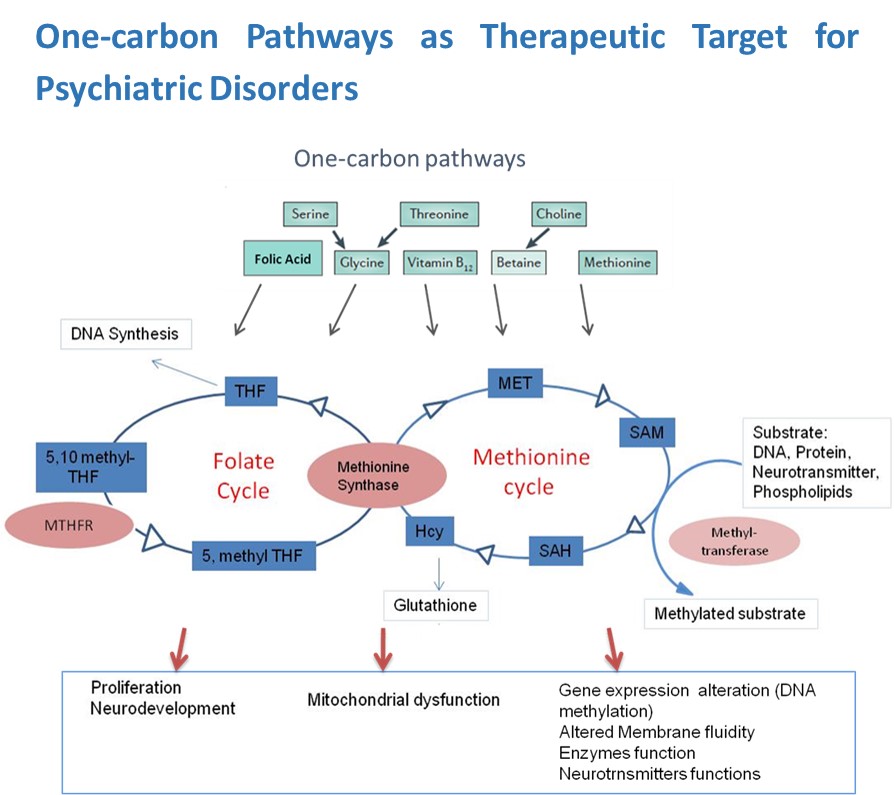 Nutritional aversive conditions during pregnancy such as famine or over-nutrition can significantly disrupt fetal development and contribute to long-term cognitive deficits in the offspring. We focus our studies in this project on how these deficits result primarily from dysregulations of one-carbon metabolism and consequently that imbalances in prenatal diet are major factors in the etiology of neuropsychiatric disorders such as schizophrenia and autism.
We use animal models to investigate how the dietary manipulation of one-carbon metabolism during gestational stage can program the brain functions, alter neurodevelopment and shape the behavioral phenotypes in the offspring. The one-carbon pathway components may prompt new therapeutic options for the treatment of psychiatric disorders.
Approaches
 Mice that have genes deleted (knock out) or genes added (knock in) are used to study the role of specific genes in normal and abnormal behaviors. We examine mouse behaviors using wide range of assays including: sociability, social novelty, open filed, elevated maze, forced swim, sucrose preference, different types of memory (working memory using T-maze, novel object recognition, novel location recognition, cued and contextual fear conditioning).
We dissect the brain to analyze the changes in neurotransmitter circuit, metabolites, gene expression. We utilize immunohistochemistry, in situ hybridization, LC-MS analysis, qPCR and other chemical methods.